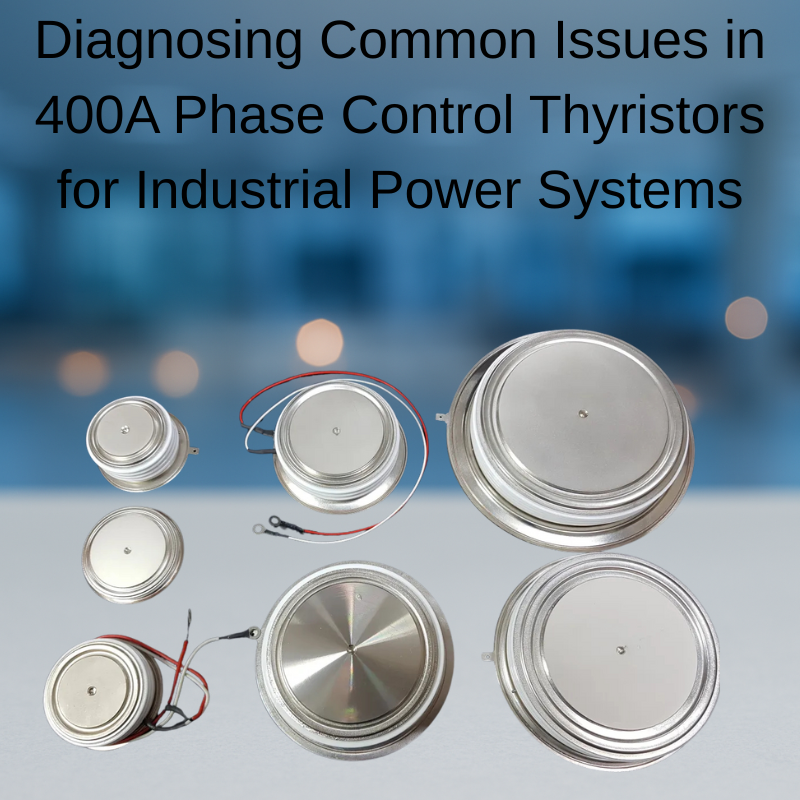
Optimizing System Integration and Long-Term Reliability of 600A Phase Control Thyristors
The 600A phase control thyristor has become a key component in industrial automation, motor control, and high-power rectification systems. With its high thermal stability, high surge current rating, and high dv/dt immunity, it is engineered for durability and efficiency under heavy electrical loads. Moreover, its extended temperature range (–40°C to +85 °C) and low leakage current enable continuous operation in harsh environmental conditions. To fully leverage its performance, engineers must not only focus on the component itself but also on system-level integration and long-term maintenance strategies that ensure stable operation throughout its service life.
Proper integration of 600A phase control thyristors within a system determines how efficiently they perform. While individual device specifications guarantee high thermal stability and high junction temperature tolerance, system-level factors—such as cooling design, current balancing, and gate control synchronization—are equally important.
Cooling efficiency: A high-performance thyristor depends on the effective removal of heat from its junction. Even with high thermal stability, thermal buildup due to poor airflow or insufficient heat sink contact can cause gradual degradation. Current balancing: In multi-device configurations, uneven current sharing leads to overload in one or more devices. This reduces the effectiveness of the high surge current rating and can result in early failures. Gate trigger synchronization: To maintain proper conduction, gate signals must be timed precisely across parallel thyristors. Irregular triggering not only increases heat dissipation but also compromises high dv/dt immunity.
An integrated approach that addresses these issues at the design stage ensures consistent performance and reduces maintenance demands later.
For 600A phase control thyristors, environmental factors such as temperature, humidity, and contamination play a major role in determining long-term performance.
Temperature variation: The extended temperature range (–40°C to +85 °C) ensures stable operation in both cold outdoor installations and high-temperature production facilities. However, maintaining consistent thermal contact between the thyristor’s housing and the heat sink is crucial to preventing uneven heat distribution. Humidity and dust protection: Surface contamination can compromise low leakage current characteristics. Protective coatings and sealed enclosures help maintain insulation integrity in dusty or humid environments. Vibration control: Mechanical stress can gradually damage solder joints and packaging. Using vibration-damping mounts prevents microfractures that could impact high junction temperature tolerance over time.
By designing systems that actively manage environmental exposure, engineers can preserve electrical stability and extend operational life.
Advanced monitoring systems can detect subtle performance deviations before they escalate into critical failures. The following parameters are key to predictive maintenance of 600A phase control thyristors:
Temperature logging: Continuous temperature tracking identifies loss of high thermal stability and signals the need for heat sink cleaning or re-greasing. Leakage current monitoring: Maintaining a stable low leakage current under normal operating voltage confirms the device’s insulation and junction integrity. dv/dt event tracking: Monitoring transient voltage events ensures that high dv/dt immunity remains intact under load changes. Load pattern analysis: Reviewing load cycles helps verify that the system is operating within its high surge current rating, preventing fatigue damage from repetitive stress.
Incorporating IoT-based data acquisition systems allows for automatic alerts when performance thresholds are breached, making preventive actions more efficient and reducing unplanned downtime.
A manufacturing facility using 600A thyristor-based motor drives reported inconsistent torque output and occasional overcurrent trips. Analysis revealed that uneven cooling across modules caused one thyristor to operate above its extended temperature range (–40°C to +85 °C) limit. Engineers redesigned the air-cooling ducts, re-applied high-conductivity grease to improve high thermal stability, and recalibrated the gate drivers for uniform triggering. The results were remarkable — leakage current was reduced by 40%, surge performance improved, and operational uptime exceeded 12,000 hours without failure.
Achieving long-term reliability in 600A phase control thyristor systems depends on a balance between component capability and system-level design. Ensuring high thermal stability, maintaining low leakage current, and respecting high surge current rating limits form the foundation of stable performance. By designing with the extended temperature range (–40°C to +85 °C) and implementing predictive monitoring for high dv/dt immunity, engineers can create systems that not only perform efficiently but also endure years of heavy-duty operation.
Through proper integration, environmental adaptation, and proactive maintenance, 600A phase control thyristors can deliver consistent, safe, and efficient performance in industrial applications worldwide.