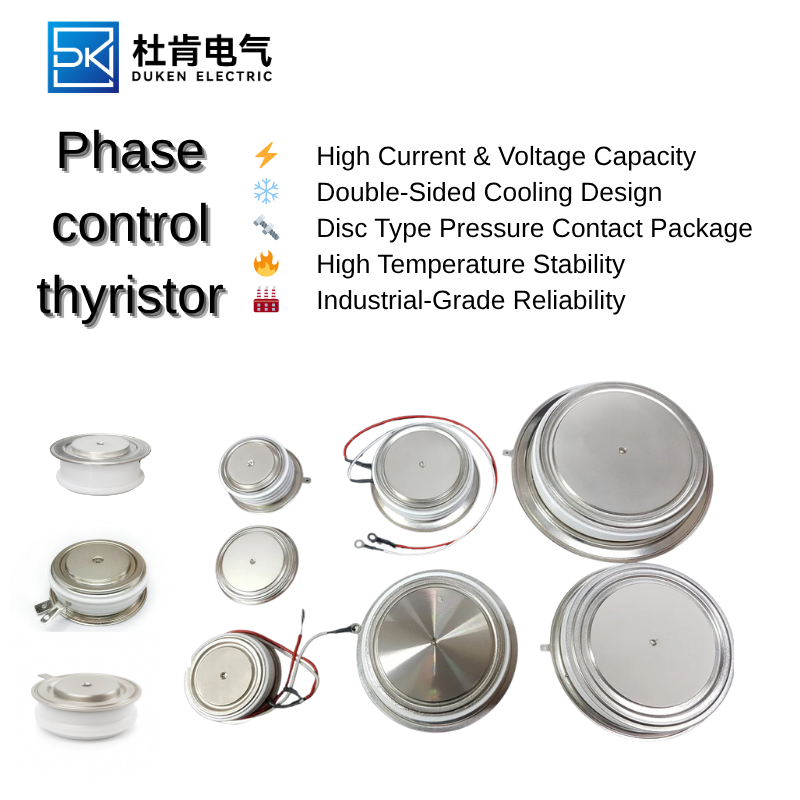
Why 6500V VRRM Matters in 3000A Phase Control Thyristor Applications
When engineers specify a thyristor for industrial DC rectifiers, they are not simply buying current capacity. They are defining how much electrical stress the converter can safely withstand over years of operation. A 3000A phase control thyristor for DC rectifier duty is expected to survive repeated switching, large thermal swings, and unpredictable line behavior. In many heavy-load installations, the specification mining equipment power control 6500 V VRRM 3000A phase control thyristor signals a need for extra reverse blocking strength to protect against transients and abnormal supply conditions. In noisy process environments, electromagnetic heating systems high dv/dt immunity 3000A phase control thyristor requirements add another layer of protection by reducing false triggering risk. At the same time, systems that depend on gradual current ramping benefit from soft-start motor drive low on-state voltage drop 3000A phase control thyristor performance, where efficiency and controlled heating are closely linked.
The Meaning of VRRM in Real Operating Conditions
VRRM, or repetitive peak reverse voltage, describes the maximum reverse voltage the device can block repeatedly during normal operation. In practical terms, it is one of the most important safeguards in a high-power rectifier. Industrial power lines are rarely perfect. Harmonics, switching spikes, transformer behavior, and line disturbances can all create reverse stress above nominal expectations.
A higher VRRM rating increases design margin. That margin becomes especially valuable in systems with long cable lengths, remote substations, or large inductive loads. These are typical features in field equipment and mineral processing operations, which explains the relevance of mining equipment power control 6500 V VRRM 3000A phase control thyristor requirements. In such environments, a generous reverse voltage capability helps the rectifier survive events that would challenge a lower-rated device.
Engineers often discover that insufficient voltage margin does not always cause immediate catastrophic failure. Sometimes it shows up first as gradual degradation, increased leakage, unstable triggering, or shortened lifetime. For that reason, high VRRM should be seen as a reliability tool, not just a headline number on a datasheet.
How Voltage Margin Supports System Reliability
The value of high reverse blocking capability becomes clearer when the full converter system is considered. Snubber circuits, surge suppressors, and firing controls all help manage stress, but none of them eliminate electrical transients completely. A stronger thyristor provides the final line of defense when real-world disturbances exceed theoretical expectations.
In mining and heavy transport systems, the electrical environment can be especially severe. Load switching, mechanical vibration, and variable utility quality can combine to produce unpredictable conditions. This is why design teams often favor solutions associated with mining equipment power control 6500 V VRRM 3000A phase control thyristor performance. Extra reverse voltage strength gives the rectifier better survivability and reduces the risk of forced maintenance in difficult service locations.
At the same time, voltage stress is not the only challenge. Electromagnetic heating equipment exposes components to fast waveform changes and strong electrical noise. Under these circumstances, electromagnetic heating systems high dv/dt immunity 3000A phase control thyristor capability becomes essential. Even a device with excellent VRRM can create system problems if it is vulnerable to false turn-on caused by excessive dv/dt.
The Interaction Between Electrical and Thermal Stress
A thyristor’s life is shaped by the interaction between electrical margin and thermal control. Overvoltage events can weaken the device, while excessive heat accelerates material fatigue and parameter drift. For a 3000A component, efficient conduction matters because heat generation scales quickly under continuous current.
This is where soft-start motor drive low on-state voltage drop 3000A phase control thyristor performance adds practical value. Lower on-state voltage drop reduces conduction loss and limits junction temperature rise. In high-cycle motor systems, the benefit can be substantial because each start event contributes to cumulative heating. Better thermal efficiency means the device can operate farther from its critical limits, improving reliability over time.
The same principle applies in rectifier bridges that feed electrolysis, charging, or process current systems. Lower loss reduces not only device temperature but also stress on heatsinks, cooling fans, and surrounding insulation materials. A balanced design therefore depends on both strong blocking voltage and controlled thermal behavior.
A Better Basis for High-Power Thyristor Selection
Engineers choosing a 3000A thyristor should avoid relying on a single parameter. A high VRRM rating is valuable, but it must be paired with suitable surge current performance, thermal resistance, gate control behavior, and mechanical assembly quality. The correct decision depends on how all of these factors interact under real load conditions.
Where long-term ruggedness is the priority, mining equipment power control 6500 V VRRM 3000A phase control thyristor specifications provide a useful standard. Where noise immunity is central, electromagnetic heating systems high dv/dt immunity 3000A phase control thyristor capability becomes indispensable. Where energy loss and thermal accumulation must be minimized, soft-start motor drive low on-state voltage drop 3000A phase control thyristor characteristics improve efficiency and service life.
Ultimately, 6500V VRRM matters because it creates operating margin in a world where industrial power conditions are not perfectly controlled. In a 3000A phase control thyristor, that margin can be the difference between dependable production and avoidable shutdown. For high-power DC rectifiers, voltage strength is not simply a specification; it is a foundation for reliability.