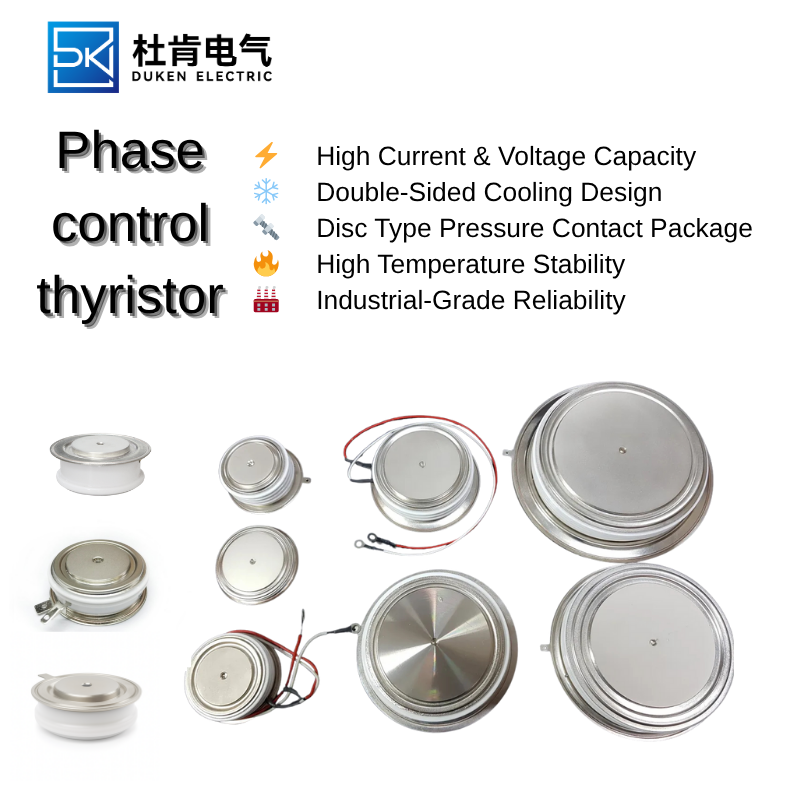
Establishing Thermal Endurance Benchmarks: High Thermal Stability Testing for 2200A Thyristors
Introduction
Industrial battery chargers are essential to mission-critical systems ranging from power plants to backup infrastructure. At their core, components like the 2200A phase control thyristor govern the performance and reliability of power conversion. These thyristors must endure elevated temperatures, repetitive cycling, and long operating hours. As a result, creating and applying robust testing standards for high thermal stability for industrial battery chargers 2200A phase control thyristor becomes paramount.
In this article, we dive deep into the importance of high-temperature testing, the nature of thermal stress in industrial charger applications, and the testing methodologies used to validate the high thermal stability for industrial battery chargers 2200A phase control thyristor across production and operation phases.
1. Why Thermal Stability Matters in Battery Charging Systems
Industrial battery chargers operate in environments where both ambient heat and internal heat generation can threaten device integrity. Over prolonged operation, semiconductors experience shifts in electrical characteristics that may lead to inefficiencies or even failure. For a high thermal stability for industrial battery chargers 2200A phase control thyristor, the challenge is compounded by the high current it conducts—often exceeding thousands of amperes.
Without high thermal stability, a 2200A phase control thyristor may exhibit:
Increased leakage currents
Unpredictable gate triggering
Accelerated material fatigue
Reduced lifecycle under cyclic heating
Thus, thermal performance testing isn’t just about survivability—it’s about sustaining long-term electrical accuracy and protecting the entire charging infrastructure.
2. Key Thermal Tests for 2200A Phase Control Thyristors
Testing standards for high thermal stability for industrial battery chargers 2200A phase control thyristor should be rigorous and application-specific. Common thermal assessments include:
a. Thermal Cycling Tests:
This test rapidly exposes the device to alternating high and low temperatures. For the 2200A device, this simulates start-stop charger cycles, load surges, and varying environmental conditions. Each cycle stresses internal bonds, interfaces, and the silicon itself. A pass means the device can maintain electrical integrity and mechanical stability even under repeated expansion and contraction.
b. Steady-State Temperature Load Testing:
Here, the thyristor is operated at full load until a thermal equilibrium is reached. Its junction temperature, case temperature, and forward voltage drop are monitored. The aim is to verify the high thermal stability for industrial battery chargers 2200A phase control thyristor over sustained operation.
c. Power Derating Characterization:
By simulating ambient temperatures from -40°C to +125°C, this test measures how the thyristor’s performance degrades. An ideal 2200A phase control thyristor with high thermal stability will exhibit gradual, predictable derating without sudden thresholds.
3. Integration Insights: From Testing to Real-World Deployment
Testing data helps engineers determine where and how the 2200A phase control thyristor should be deployed. For example:
In hot climates, a unit proven to deliver high thermal stability for industrial battery chargers 2200A phase control thyristor can be installed with smaller heatsinks or passive cooling, reducing system cost.
When used in modular charger arrays, thermally stable thyristors improve load sharing and prolong system uptime.
Tested and thermally rated thyristors also simplify integration with safety features like thermal cutoffs, digital temperature sensors, and intelligent gate drivers.
4. Long-Term Reliability and Manufacturer Standards
Manufacturers must embed thermal reliability checks throughout the production process—not just during final QA. This includes wafer-level burn-in, die attach quality inspections, and package hermeticity testing.
Suppliers offering high thermal stability for industrial battery chargers 2200A phase control thyristor often publish extensive datasheets and thermal resistance models, enabling designers to simulate thermal behavior accurately before deployment.
Customers, in turn, must use this data to validate installation configurations, ensuring adequate ventilation, heatsinking, and thermal interface materials are applied.
Conclusion
The ability of a high thermal stability for industrial battery chargers 2200A phase control thyristor to withstand extreme thermal conditions isn’t just an optional feature—it’s a foundation for safety, reliability, and operational continuity. Testing standards, including thermal cycling and long-term heat load validation, allow manufacturers and end-users to confidently integrate these high-current devices into critical charging systems. As battery technology evolves, so must the thermal endurance of its supporting electronics.
Introduction
Industrial battery chargers are essential to mission-critical systems ranging from power plants to backup infrastructure. At their core, components like the 2200A phase control thyristor govern the performance and reliability of power conversion. These thyristors must endure elevated temperatures, repetitive cycling, and long operating hours. As a result, creating and applying robust testing standards for high thermal stability for industrial battery chargers 2200A phase control thyristor becomes paramount.
In this article, we dive deep into the importance of high-temperature testing, the nature of thermal stress in industrial charger applications, and the testing methodologies used to validate the high thermal stability for industrial battery chargers 2200A phase control thyristor across production and operation phases.
1. Why Thermal Stability Matters in Battery Charging Systems
Industrial battery chargers operate in environments where both ambient heat and internal heat generation can threaten device integrity. Over prolonged operation, semiconductors experience shifts in electrical characteristics that may lead to inefficiencies or even failure. For a high thermal stability for industrial battery chargers 2200A phase control thyristor, the challenge is compounded by the high current it conducts—often exceeding thousands of amperes.
Without high thermal stability, a 2200A phase control thyristor may exhibit:
Increased leakage currents
Unpredictable gate triggering
Accelerated material fatigue
Reduced lifecycle under cyclic heating
Thus, thermal performance testing isn’t just about survivability—it’s about sustaining long-term electrical accuracy and protecting the entire charging infrastructure.
2. Key Thermal Tests for 2200A Phase Control Thyristors
Testing standards for high thermal stability for industrial battery chargers 2200A phase control thyristor should be rigorous and application-specific. Common thermal assessments include:
a. Thermal Cycling Tests:
This test rapidly exposes the device to alternating high and low temperatures. For the 2200A device, this simulates start-stop charger cycles, load surges, and varying environmental conditions. Each cycle stresses internal bonds, interfaces, and the silicon itself. A pass means the device can maintain electrical integrity and mechanical stability even under repeated expansion and contraction.
b. Steady-State Temperature Load Testing:
Here, the thyristor is operated at full load until a thermal equilibrium is reached. Its junction temperature, case temperature, and forward voltage drop are monitored. The aim is to verify the high thermal stability for industrial battery chargers 2200A phase control thyristor over sustained operation.
c. Power Derating Characterization:
By simulating ambient temperatures from -40°C to +125°C, this test measures how the thyristor’s performance degrades. An ideal 2200A phase control thyristor with high thermal stability will exhibit gradual, predictable derating without sudden thresholds.
3. Integration Insights: From Testing to Real-World Deployment
Testing data helps engineers determine where and how the 2200A phase control thyristor should be deployed. For example:
In hot climates, a unit proven to deliver high thermal stability for industrial battery chargers 2200A phase control thyristor can be installed with smaller heatsinks or passive cooling, reducing system cost.
When used in modular charger arrays, thermally stable thyristors improve load sharing and prolong system uptime.
Tested and thermally rated thyristors also simplify integration with safety features like thermal cutoffs, digital temperature sensors, and intelligent gate drivers.
4. Long-Term Reliability and Manufacturer Standards
Manufacturers must embed thermal reliability checks throughout the production process—not just during final QA. This includes wafer-level burn-in, die attach quality inspections, and package hermeticity testing.
Suppliers offering high thermal stability for industrial battery chargers 2200A phase control thyristor often publish extensive datasheets and thermal resistance models, enabling designers to simulate thermal behavior accurately before deployment.
Customers, in turn, must use this data to validate installation configurations, ensuring adequate ventilation, heatsinking, and thermal interface materials are applied.
Conclusion
The ability of a high thermal stability for industrial battery chargers 2200A phase control thyristor to withstand extreme thermal conditions isn’t just an optional feature—it’s a foundation for safety, reliability, and operational continuity. Testing standards, including thermal cycling and long-term heat load validation, allow manufacturers and end-users to confidently integrate these high-current devices into critical charging systems. As battery technology evolves, so must the thermal endurance of its supporting electronics.