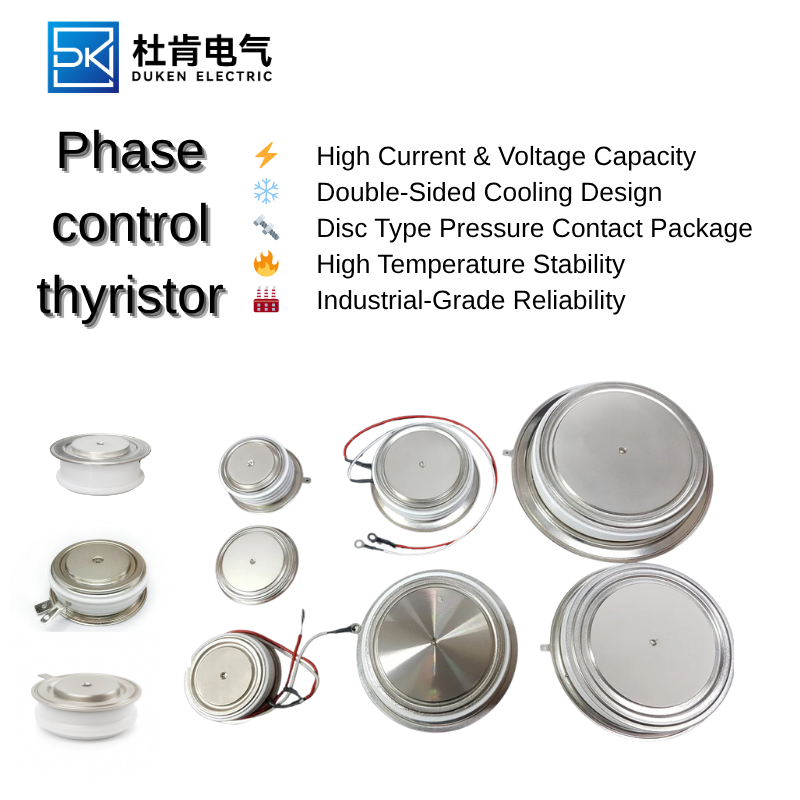
How 3000A Phase Control Thyristors Improve DC Rectifier Reliability in Heavy Industry
In modern industrial power conversion, component selection determines whether a rectifier system runs steadily for years or becomes a source of repeated downtime. Engineers working in smelting plants, mineral processing facilities, and high-demand manufacturing lines often need devices that can tolerate high current, elevated thermal stress, and rapid load changes without losing stability. A 3000A phase control thyristor for DC rectifier applications is often chosen because it combines rugged current capability with predictable switching behavior in harsh operating conditions. When a project involves mining equipment power control 6500 V VRRM 3000A phase control thyristor, designers are usually looking for more than a current rating; they want safety margin, insulation confidence, and long-term durability. At the same time, applications linked to electromagnetic heating systems high dv/dt immunity 3000A phase control thyristor demand immunity against electrical noise and sudden voltage transients. For motor starting and torque management, the role of a soft-start motor drive low on-state voltage drop 3000A phase control thyristor becomes equally important because efficiency and thermal performance must go hand in hand.
Operating Demands in DC Rectifier Systems
A DC rectifier in industrial service rarely works under ideal laboratory conditions. Real installations face dust, vibration, voltage fluctuation, overload events, and repeated thermal cycling. In these environments, the thyristor cannot be evaluated only by nominal current. Reverse blocking capability, surge current tolerance, gate trigger stability, thermal resistance, and package robustness all affect operating life.
A 3000A device installed in a high-power rectifier bridge must maintain stable conduction even when load demand changes sharply. If the rectifier serves electrochemical processing or ore handling systems, the load profile may be highly dynamic. During startup, acceleration, or fault recovery, momentary stress can rise far above the average operating level. For this reason, engineers usually examine not just average current ratings, but the total system margin available under peak conditions.
Reverse repetitive voltage rating is especially critical in large rectifier circuits. Higher VRRM values provide a wider safety envelope against transient overvoltage and line disturbances. This is one reason the specification behind mining equipment power control 6500 V VRRM 3000A phase control thyristor attracts attention in heavy-duty environments. A stronger blocking capability reduces the risk of premature failure when utility conditions are unstable or when switching events generate high electrical stress.
Why Electrical Robustness Matters
Industrial rectifier designs often operate near large transformers, long busbars, and inductive loads, all of which can create steep voltage changes. In such cases, dv/dt performance becomes a real design priority rather than a marketing phrase. If a thyristor has poor dv/dt tolerance, unwanted turn-on can occur, leading to heat buildup, control errors, or even bridge damage.
This is why engineers in thermal processing and induction applications often focus on electromagnetic heating systems high dv/dt immunity 3000A phase control thyristor characteristics. In these systems, switching noise and fast voltage transitions are not rare exceptions; they are part of the operating environment. A thyristor with strong dv/dt immunity helps maintain controlled firing behavior and reduces the chance of false triggering under interference.
Low on-state voltage drop is another overlooked but valuable parameter. In a 3000A device, even a small reduction in conduction loss can significantly reduce total heat generation over long operating cycles. Lower dissipation improves efficiency, eases heatsink demand, and supports more stable junction temperature. That is why the concept behind soft-start motor drive low on-state voltage drop 3000A phase control thyristor is attractive in systems where current flows for extended periods and thermal control directly affects service life.
Thermal Performance and Service Life
The true cost of a thyristor is not its purchase price alone. It is the total lifecycle value created by reliability, maintenance intervals, and reduced shutdown risk. A robust 3000A phase control thyristor can protect this value by operating consistently at high current while staying within acceptable junction temperature limits.
Thermal management must be considered as a complete chain: device package, contact quality, heatsink flatness, clamping force, interface material, airflow, and ambient temperature. Even a high-quality thyristor can underperform if the thermal path is poorly engineered. Conversely, a well-mounted device with adequate cooling can deliver long operating life under demanding conditions.
In motor starting circuits, repeated inrush events create thermal pulses that accumulate over time. Here, soft-start motor drive low on-state voltage drop 3000A phase control thyristor selection improves more than efficiency; it reduces thermal cycling amplitude, which is one of the hidden causes of aging. In rectifier bridges handling unstable industrial loads, the same logic applies: lower conduction loss usually means lower mechanical and thermal stress on the full assembly.
For extraction plants and bulk material systems, the need behind mining equipment power control 6500 V VRRM 3000A phase control thyristor is closely tied to reliability planning. Equipment in remote sites may not allow frequent replacement or easy maintenance access. A stronger device margin can therefore reduce emergency intervention and improve production continuity.
Application Fit and Long-Term Value
The best thyristor choice is always application-specific, but some selection principles remain universal. Engineers should compare VRRM, IT(AV), ITSM, gate trigger parameters, dv/dt capability, thermal resistance, and mechanical mounting requirements in one coordinated review. They should also consider whether the rectifier operates continuously, cyclically, or under frequent overload conditions.
In high-noise heating installations, the demands implied by electromagnetic heating systems high dv/dt immunity 3000A phase control thyristor guide engineers toward devices with stronger transient tolerance and dependable trigger control. In large motor systems, soft-start motor drive low on-state voltage drop 3000A phase control thyristor performance supports lower losses and smoother thermal behavior. In rugged field power systems, mining equipment power control 6500 V VRRM 3000A phase control thyristor specifications point to the need for stronger blocking performance and durable operation.
A well-selected 3000A phase control thyristor does more than switch current. It stabilizes the rectifier, protects uptime, and gives industrial users a more predictable power platform for demanding DC applications.