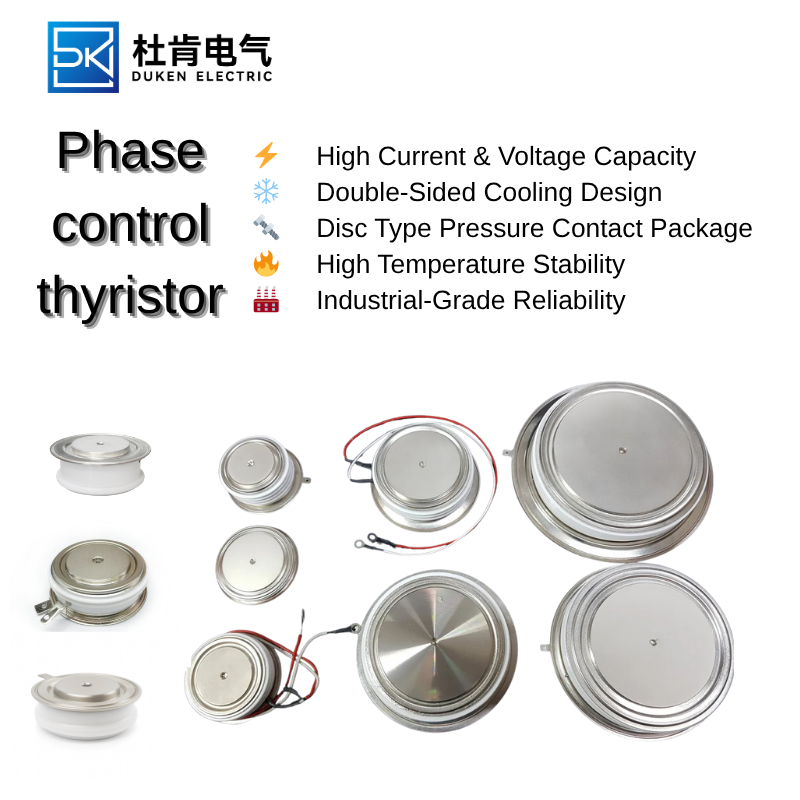
Industrial Applications of 800A Phase Control Thyristors in Controlled Rectification
Controlled rectification is widely used wherever an industrial process requires adjustable DC voltage or current. Applications include electroplating, electrolysis, battery charging, DC motor drives, welding, induction heating support systems, magnet power supplies, and utility control equipment. In these systems, the phase control thyristor remains a practical solution because it combines high current capacity, robust surge performance, and straightforward control.
An 800A phase control thyristor is particularly useful in medium- and high-power equipment where reliability is more important than extremely high switching frequency. The device operates at line frequency or a multiple of line frequency, reducing switching losses and simplifying the power stage. Its controlled turn-on allows the system to regulate output through the firing angle of the AC waveform.
1. Process Rectifiers and DC Motor Loads
Electrochemical processes often require a stable and adjustable current. In electroplating, changes in current density affect coating thickness, surface finish, and production consistency. In electrolysis, output current influences reaction rate and energy consumption. A thyristor-controlled bridge allows the operator or automation system to regulate process current over a wide range.
DC motor drives use similar control principles. By changing the average armature voltage, the rectifier adjusts motor speed and torque. Large motors may generate regenerative energy during deceleration, so the bridge configuration and protection system must be selected for the intended operating quadrants.
In both applications, the 800A rating provides useful overload capability. Motors can draw high current during acceleration, while electrochemical loads may experience temporary disturbances or short circuits. Fast-acting semiconductor fuses, current transformers, and electronic trip logic help protect the thyristor during these events.
2. Battery Charging and Backup Power
Battery charging is one of the most established applications for controlled rectifiers. Large stationary battery banks require dependable float charging, boost charging, current limiting, and fault protection. The thyristor bridge can regulate charging output according to battery voltage, temperature, and operating mode.
A battery charging rectifier robust insulation for high voltage 300A phase control thyristor can be used in substations and industrial backup systems where electrical isolation is essential. High-voltage insulation protects personnel and control equipment while reducing the chance of leakage or flashover between live parts and grounded structures.
For larger battery banks, an 800A device may be used in the main charging bridge, while a battery charging rectifier robust insulation for high voltage 300A phase control thyristor may serve a smaller branch, redundant module, or auxiliary charging channel. Using different current classes within one installation allows the system to match semiconductor capacity to the actual load.
Battery rooms may contain corrosive vapors, elevated humidity, and restricted ventilation. The cabinet should therefore include corrosion-resistant hardware, protected circuit boards, appropriate airflow, and safe separation between power and control sections. A long-life battery charging rectifier robust insulation for high voltage 300A phase control thyristor installation also requires regular cleaning, connection checks, and insulation-resistance testing.
3. Reactive Power and Voltage Regulation
Industrial plants with large motors, furnaces, transformers, and rapidly changing loads can experience poor power factor and unstable voltage. Static VAR compensators correct these problems by adjusting reactive power in response to network conditions.
A static VAR compensator (SVC) high dv/dt immunity 300A phase control thyristor is commonly associated with thyristor-controlled reactors or switched capacitor branches. Because the device may block substantial voltage before receiving a gate command, immunity to rapid voltage rise is a critical characteristic.
An 800A thyristor can support higher-current branches in large SVC installations. However, the complete system must coordinate the semiconductor, reactor, capacitor bank, protection relays, harmonic filters, and control software. A static VAR compensator (SVC) high dv/dt immunity 300A phase control thyristor cannot compensate for an incorrectly designed snubber or an unstable firing algorithm.
Harmonic generation must also be considered. Phase-controlled reactors draw non-sinusoidal current, so harmonic filters are often installed to maintain network quality. A properly engineered static VAR compensator (SVC) high dv/dt immunity 300A phase control thyristor branch combines accurate firing control, strong transient protection, and effective harmonic management.
4. Harsh-Environment Switching Systems
Industrial power equipment is frequently installed outside climate-controlled rooms. Mining operations, ports, railways, renewable-energy facilities, and remote utility stations may experience extreme seasonal temperatures, dust, vibration, and moisture.
A high current switching device extended temperature range (–40°C to +85 °C) 300A phase control thyristor is suitable for such environments when the surrounding components are rated accordingly. The device must start reliably at low temperature and maintain acceptable leakage and thermal performance at high temperature.
An 800A thyristor used in the same environment requires conservative derating. Cooling fans may deliver less airflow when filters are clogged, while high altitude reduces air density and cooling performance. A high current switching device extended temperature range (–40°C to +85 °C) 300A phase control thyristor assembly should therefore be tested under realistic airflow, altitude, and enclosure conditions.
Mechanical design also matters. Vibration can loosen fasteners or damage gate leads, while condensation can reduce insulation resistance. A dependable high current switching device extended temperature range (–40°C to +85 °C) 300A phase control thyristor system uses secure clamping, strain relief, environmental sealing, conformal protection, and continuous temperature monitoring.
Conclusion
The 800A phase control thyristor remains valuable in industrial systems that require adjustable high-current DC output, strong surge capability, and proven line-frequency operation. It can support process rectifiers, DC drives, charging equipment, reactive power compensators, and harsh-environment switching systems.
Application success depends on correct system integration. Engineers must combine the thyristor with suitable transformers, gate controls, fuses, snubbers, heat sinks, insulation materials, sensors, and maintenance procedures. When these elements are properly coordinated, controlled rectification can deliver efficient, stable, and dependable power across a wide range of industrial processes.