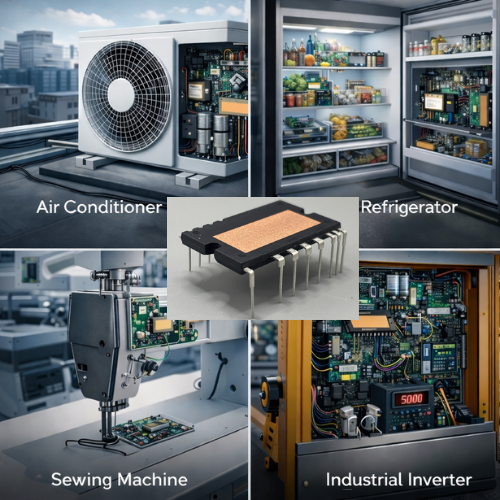
Standard Footprint, Smarter Protection: What Makes the DK20S60NXD Easy to Integrate
Ease of integration has become a decisive factor in motor-driver selection. In many appliance projects, design teams do not fail because they lack switching devices. They fail because the solution is too difficult to implement consistently, too sensitive to layout variation, or too vulnerable to real-world operating faults. This is why integrated intelligent power modules have become increasingly valuable. Among them, the DK20S60NXD stands out for combining compact integration with practical protection.
Integration problems often start before power-up
A motor-control design may look acceptable on paper but still create serious engineering problems during prototyping or mass production. Layout constraints, isolation issues, thermal interaction, and protection coordination can all slow development. When the motor driver requires too many external decisions, every product revision becomes more complex and more error-prone.
A solution with standard footprint with short-circuit protection thermal protection 600V 20A Intelligent Power Module characteristics helps address that challenge by giving engineers a more repeatable foundation. A standard footprint reduces mechanical and PCB uncertainty. Short-circuit and thermal protection improve fault resilience. Together, these features support a smoother path from schematic to qualified product.
Why standard footprint matters
Faster design reuse
Appliance makers often develop multiple products on shared inverter architecture. A familiar mechanical and electrical footprint allows a design team to carry proven layout concepts from one model to another. That reduces development risk and can shorten validation cycles. A module with standard footprint with short-circuit protection thermal protection 600V 20A Intelligent Power Module value is therefore not limited to convenience; it directly supports platform strategy.
Easier sourcing and revision control
A standard package structure can also simplify second-generation updates and manufacturing process control. When physical integration is predictable, redesign effort stays focused on performance improvements rather than basic hardware accommodation. For companies managing several appliance categories, this is a major practical advantage.
Protection features support cleaner system design
Protection functions are often treated as insurance, but in reality they influence the entire architecture. If short-circuit handling and thermal awareness are embedded intelligently, the surrounding control and monitoring circuits can be designed more efficiently. This does not eliminate system-level engineering, but it gives the designer a stronger baseline.
This becomes particularly useful for refrigerator compressor for air conditioner drives with elevated duty cycle 600V 20A Intelligent Power Module applications. Compressors place high demands on continuity of operation and thermal endurance. A module that can better support abnormal-event handling contributes to quieter operation, reduced field failures, and improved customer satisfaction over the product’s lifetime.
DK20S60NXD in multi-appliance platform design
Refrigerator and air-conditioner applications
When selecting a power module for refrigerator compressor for air conditioner drives with elevated duty cycle 600V 20A Intelligent Power Module needs, engineers usually focus on three things: thermal performance, efficiency over long run times, and reliability during repeated starts or load fluctuations. The DK20S60NXD addresses these priorities in a compact integrated structure that helps simplify inverter implementation.
The result is not just an easier schematic. It is a more manageable product-development process. With fewer variables in gate-drive arrangement and power-stage assembly, teams can spend more effort on control algorithms, thermal optimization, and acoustic tuning.
Washing-machine applications
The same integration logic applies for washing machines optimized for cost-performance with isolated gate driver 600V 20A Intelligent Power Module design goals. Washing-machine platforms are usually under stronger cost pressure, so layout efficiency and part-count reduction matter even more. The isolated gate-driver arrangement improves control-side robustness, while the overall integrated package helps manufacturers manage both cost and reliability in a balanced way.
Real engineering value beyond datasheet numbers
It is easy to compare modules by current rating and voltage class alone, but those numbers do not reveal the full design experience. What matters in practice is how reliably the module behaves in a real appliance inverter, how much layout burden it imposes, and how much external protection complexity it adds or removes.
A package with standard footprint with short-circuit protection thermal protection 600V 20A Intelligent Power Module benefits helps answer those questions positively. Likewise, appliance makers working for washing machines optimized for cost-performance with isolated gate driver 600V 20A Intelligent Power Module requirements can gain from cleaner control integration and reduced development friction. And in compressor systems, designers choosing for refrigerator compressor for air conditioner drives with elevated duty cycle 600V 20A Intelligent Power Module solutions can focus more on load-specific optimization instead of fighting basic implementation issues.
A better fit for scalable product development
The DK20S60NXD is especially attractive for manufacturers building scalable appliance portfolios. Instead of treating each inverter design as a separate engineering project, they can standardize around a module family that covers multiple needs. That saves effort in testing, documentation, production training, and long-term support.
At the same time, the module remains grounded in practical application value. It serves teams for washing machines optimized for cost-performance with isolated gate driver 600V 20A Intelligent Power Module goals while also delivering strong relevance in compressor-driven systems. That breadth of usefulness is one of its clearest strengths.
Conclusion
The DK20S60NXD is easy to integrate not because it is simple in the abstract, but because it solves real engineering problems. Its standard footprint, built-in protection, and application flexibility help reduce development risk and improve design consistency. For appliance makers seeking a dependable motor-driver foundation, that combination is highly compelling.