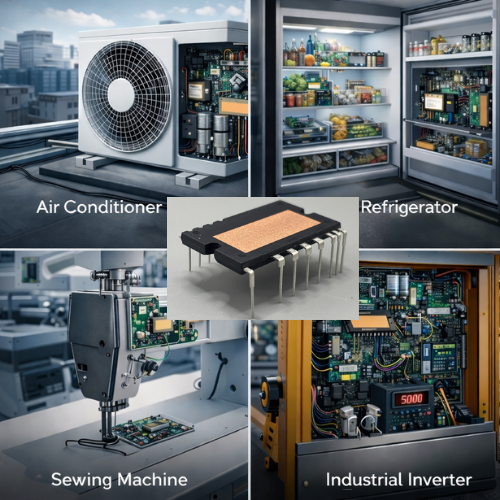
How to Choose an Efficient and Safe Motor Driver for Modern Home Appliances
Selecting a motor driver is no longer a simple matter of matching voltage and current ratings. In modern household appliances, designers must balance safety, efficiency, thermal stability, control accuracy, electromagnetic compatibility, and long-term reliability. Whether the target application is a refrigerator, an air conditioner, or a washing machine, the motor driver directly influences energy consumption, acoustic comfort, product lifespan, and maintenance risk. This is why many engineers now evaluate integrated solutions such as the DK20S60NXD when building inverter-based appliance platforms.
Why motor-driver selection matters more than ever
The motor driver is the control heart of any inverter appliance. It manages how power is switched, how torque is delivered, and how smoothly the system reacts to changing load conditions. If the driver is poorly chosen, the entire appliance can suffer from overheating, unstable startup, poor speed regulation, high noise, and shortened component life. By contrast, a properly selected intelligent module can simplify design while improving protection and operating stability.
A strong candidate should combine electrical performance with a practical engineering structure. That means looking beyond the headline voltage and current values. Protection features, package layout, thermal behavior, and gate-drive integration all matter. Many design teams specifically prefer a solution with standard footprint with short-circuit protection thermal protection 600V 20A Intelligent Power Module characteristics because it supports easier replacement, safer operation, and more consistent behavior across appliance product lines.
The first priority: safety and fault tolerance
Built-in protection reduces design risk
Motor-driver failure is rarely caused by normal operation alone. More often, trouble begins during abnormal events: sudden load changes, blocked rotors, unstable mains conditions, or poor cooling. A module with integrated protection can react faster and more predictably than a loosely assembled discrete design. This is especially important in consumer appliances, where field reliability and service cost matter as much as laboratory performance.
When comparing solutions, engineers should prioritize modules with standard footprint with short-circuit protection thermal protection 600V 20A Intelligent Power Module features because short-circuit protection helps limit catastrophic switching damage, while thermal protection adds a second layer of safety during overload or inadequate airflow. Instead of building several external protection layers from scratch, the designer starts from a more secure platform.
Stable operation under real household conditions
Home appliances do not operate in ideal environments. Refrigerators may start repeatedly throughout the day. Air conditioners often run for long periods in high ambient temperatures. Washing machines experience variable-speed cycles, sudden torque changes, and moisture-related operating stress. In all these situations, the motor driver must tolerate both electrical and environmental challenges without unstable performance.
Efficiency is not only about lower power loss
A common mistake in motor-driver selection is assuming that efficiency refers only to semiconductor conduction loss. In reality, total system efficiency includes switching behavior, control smoothness, thermal management, and the ability to reduce wasted energy across different duty cycles. A module that runs cooler often supports better efficiency indirectly because surrounding components such as capacitors and PCB materials also remain under less stress.
This is where the DK20S60NXD becomes attractive in compressor and fan applications. Designers looking for refrigerator compressor for air conditioner drives with elevated duty cycle 600V 20A Intelligent Power Module performance need a solution that handles frequent starts, long operating windows, and changing thermal loads without introducing excess loss or instability. When the switching platform is well optimized, the appliance can maintain better seasonal efficiency and quieter operation.
Application-specific fit is essential
Refrigerator compressors
Refrigerator compressors demand reliable low-speed and variable-speed control. Efficiency matters because the motor runs in repeated cycles every day, year after year. A suitable intelligent power module should support consistent startup torque, low heat generation, and predictable protection during locked-rotor or abnormal current events. For engineers designing for refrigerator compressor for air conditioner drives with elevated duty cycle 600V 20A Intelligent Power Module use cases, the key advantage is the balance between operational durability and compact inverter integration.
Air-conditioner drives
Air conditioners often face elevated duty cycles, especially in hot climates. The motor driver must sustain long periods of inverter operation while keeping losses under control. It also needs strong thermal behavior because enclosure temperatures may rise significantly in real installations. In such systems, careful module selection contributes directly to energy labels, product comfort, and long-term service reliability.
Washing machines
Washing-machine platforms are highly cost-sensitive, but they still require robust inverter control. A module for washing machines optimized for cost-performance with isolated gate driver 600V 20A Intelligent Power Module applications can help manufacturers control BOM complexity while maintaining essential safety and switching performance. The isolated gate driver aspect is valuable because it improves noise immunity and simplifies control-side protection strategy.
Integration benefits for appliance manufacturers
Engineers increasingly prefer integrated modules because they shorten development time and reduce layout uncertainty. Instead of coordinating multiple discrete switches, drivers, and protection circuits, the design team can build around a more compact and repeatable solution. A module for washing machines optimized for cost-performance with isolated gate driver 600V 20A Intelligent Power Module requirements can be especially useful in mass-production environments, where manufacturability and test consistency are crucial.
The same logic applies to cross-platform product development. If one module family can serve several appliance categories, the manufacturer gains supply-chain simplicity and engineering reuse. That is another reason many teams value packages with standard footprint with short-circuit protection thermal protection 600V 20A Intelligent Power Module design priorities. Standardized layout support can reduce redesign effort from one appliance generation to the next.
Choosing the right module in practice
The best selection process combines three questions. First, is the module safe enough under abnormal conditions? Second, is it efficient enough across the real load profile of the appliance? Third, does it simplify implementation instead of increasing integration difficulty? The DK20S60NXD stands out because it addresses all three points in a practical way. It supports compact inverter design, helps manage protection requirements, and aligns well for refrigerator compressor for air conditioner drives with elevated duty cycle 600V 20A Intelligent Power Module needs while also fitting value-oriented appliance development.
At the same time, it remains highly relevant for washing machines optimized for cost-performance with isolated gate driver 600V 20A Intelligent Power Module projects, where engineering teams want dependable control without unnecessary complexity. In short, the most efficient and safe motor driver is not merely the one with the strongest electrical headline. It is the one that fits the application, protects the system, and supports reliable production at scale.