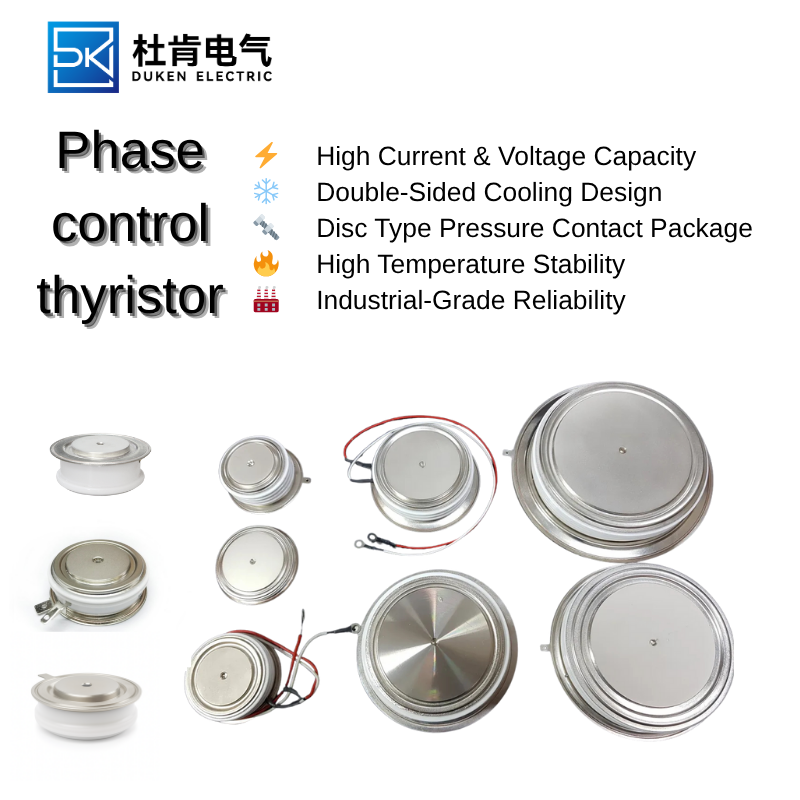
SVC Applications and the Importance of High dv/dt Immunity in 1200A Phase Control Thyristors
Static VAR compensators are essential in modern power systems where voltage stability, reactive power control, and network efficiency must be carefully managed. In these systems, component performance is deeply tied to electrical stress conditions. A 1200A phase control thyristor used in SVC equipment must not only meet current and voltage requirements, but also demonstrate dependable behavior under rapid electrical transitions. This is why high dv/dt immunity becomes a major factor in product selection and procurement strategy.
Understanding the Role of dv/dt Immunity
Dv/dt refers to the rate of change of voltage over time. In practical terms, a high dv/dt condition can challenge a semiconductor device during switching or transient events. If the thyristor does not have sufficient immunity, it may trigger unintentionally or behave unpredictably. In an SVC environment, where fast-changing electrical conditions are common, this risk cannot be ignored.
A static VAR compensator (SVC) high dv/dt immunity 1200A phase control thyristor is therefore not just a marketing phrase. It describes a device category that must survive and operate reliably in demanding power control environments. Engineers evaluating such a device should consider not only datasheet ratings, but also application evidence, thermal design, mounting requirements, and support from the supplier.
Even when the immediate project is not an SVC, buyers may compare performance expectations across applications. A battery charging rectifier robust insulation for high voltage 1200A phase control thyristor may also benefit from strong design discipline, especially where insulation reliability and controlled operation are important. Industrial buyers often gain confidence from suppliers whose product lines address several demanding use cases well.
Why SVC Projects Need Stronger Procurement Logic
SVC projects typically involve higher technical scrutiny than routine replacement purchasing. The semiconductor components are part of a broader system where dynamic response, stability, and reliability matter across long operating periods. Because of that, MOQ should be evaluated alongside validation steps. Small-batch testing may be appropriate at the start, but larger controlled orders often become necessary once the design is confirmed.
For a static VAR compensator (SVC) high dv/dt immunity 1200A phase control thyristor, buyers should ask how sample lots relate to future production lots. They should request clarity on test conditions, inspection flow, and manufacturing consistency. A low MOQ is useful for initial verification, but it is not enough by itself. In SVC procurement, confidence comes from the combination of technical transparency and repeatable supply.
This becomes even more relevant when considering environmental reliability. A high current switching device extended temperature range (–40°C to +85 °C) 1200A phase control thyristor may be required in installations where seasonal temperature swings or cabinet heat load are significant. In such cases, the buyer should link MOQ planning to thermal qualification and reserve stock planning, not just immediate build quantity.
How to Evaluate Product Fit for SVC Use
The best evaluation begins with application conditions. Engineers should define expected electrical transients, cooling method, control topology, and mechanical integration constraints. Then they should compare supplier data against those real conditions. For a battery charging rectifier robust insulation for high voltage 1200A phase control thyristor, insulation structure and controlled rectification stability may lead the discussion. For SVC use, fast transient tolerance and switching resilience move to the front.
A static VAR compensator (SVC) high dv/dt immunity 1200A phase control thyristor should also be reviewed within the wider service model of the project. Will spare units be stored on site? Will replacements need the same date-code consistency? Is there a requirement for batch traceability? These questions are highly practical and directly influence the ideal MOQ.
Meanwhile, if the same project conditions suggest the need for a high current switching device extended temperature range (–40°C to +85 °C) 1200A phase control thyristor, then the procurement team should think about long-term environmental exposure from the start. It may be better to align on medium-volume repeatable purchasing than to chase the smallest initial MOQ.
From Technical Requirement to Buying Decision
The strongest buying decisions happen when technical and commercial teams work together. Engineers identify the real stress profile of the SVC system. Procurement then negotiates sample quantity, pilot quantity, and production quantity based on that information. This prevents both overbuying and underqualification.
A static VAR compensator (SVC) high dv/dt immunity 1200A phase control thyristor deserves that level of attention because the cost of failure in service is much higher than the cost of better planning upfront. The same supplier may also support a battery charging rectifier robust insulation for high voltage 1200A phase control thyristor, showing that their design and production systems are robust across applications. And where the site environment is demanding, a high current switching device extended temperature range (–40°C to +85 °C) 1200A phase control thyristor may become the preferred selection path.
In short, SVC applications raise the standard for both product choice and MOQ strategy. Buyers who take dv/dt immunity seriously are more likely to secure a thyristor solution that performs reliably under real industrial conditions.