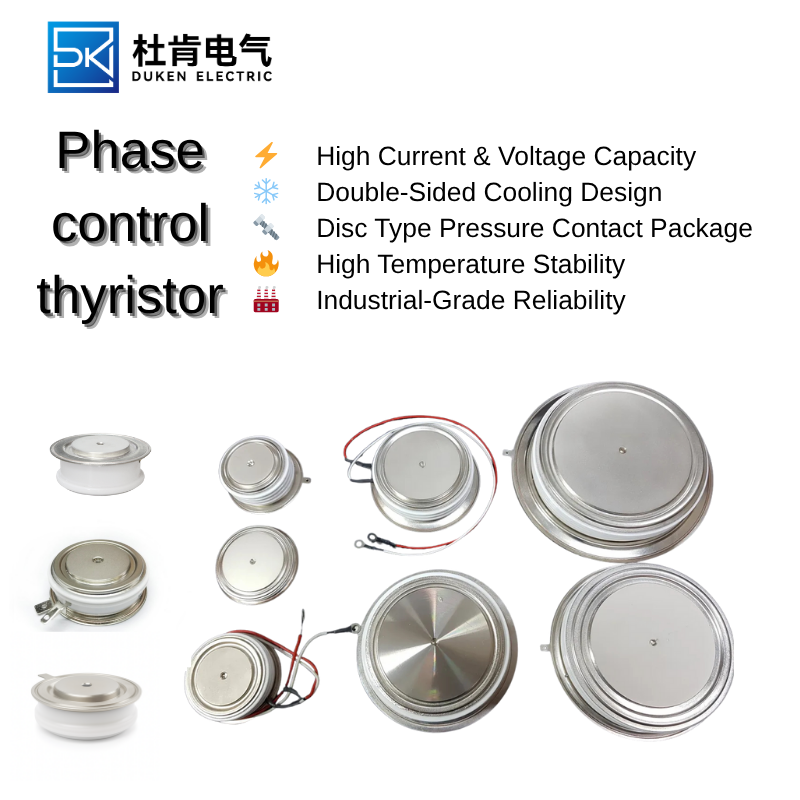
Why MOQ Strategy Matters for Battery Charging Rectifier Thyristor Procurement
In battery charging equipment, component selection directly affects system safety, charging stability, and long-term service reliability. Among the key components, the 1200A phase control thyristor plays a critical role in regulating power and supporting controlled rectification. However, buyers often focus on technical ratings and overlook an equally important question: what MOQ strategy makes sense for procurement? The answer depends on project stage, qualification method, risk control, and expected deployment volume.
The Real Purpose of MOQ in Industrial Procurement
MOQ should not be viewed only as the supplier’s sales threshold. In industrial purchasing, it is a planning tool that influences cash flow, quality verification, stock management, and production scheduling. When engineers are still validating a design, a smaller MOQ can make the process more efficient. It allows the team to confirm compatibility without overcommitting capital. Once the product is proven, a larger MOQ may improve price stability and ensure better manufacturing continuity.
This is especially true for a battery charging rectifier robust insulation for high voltage 1200A phase control thyristor. Charging rectifier systems often operate continuously and may be connected to demanding power environments. Engineers want to validate insulation integrity, electrical behavior, and temperature performance under realistic loads. During this phase, low or moderate MOQ can be highly valuable because it supports careful testing without unnecessary inventory.
At the same time, some buyers also compare cross-application capability to understand future flexibility. A product family that includes a static VAR compensator (SVC) high dv/dt immunity 1200A phase control thyristor may indicate broader engineering strength from the supplier. That does not mean the same unit should be used everywhere, but it can show that the manufacturer understands high-stress switching applications and is able to support demanding industrial requirements.
Why Battery Charging Rectifiers Require a Different Buying Approach
Battery charging rectifiers are not commodity systems in many industrial contexts. They may be used in backup power infrastructure, traction support environments, electrochemical processes, or utility-related installations. These systems depend on stable conversion behavior and predictable thermal management. A thyristor selection error can lead to poor regulation, reduced service life, or maintenance issues that cost more than the original component.
That is why the buyer should carefully review a high current switching device extended temperature range (–40°C to +85 °C) 1200A phase control thyristor when the charging system may face variable ambient conditions. Warehouses, substations, and outdoor enclosures can expose equipment to temperature extremes. In such cases, MOQ planning must be linked to the qualification schedule. The buyer may need one batch for engineering testing, one for pilot assembly, and one for field reserve.
For a battery charging rectifier robust insulation for high voltage 1200A phase control thyristor, MOQ flexibility also supports comparison between suppliers. If two options look similar on paper, pilot-volume testing can reveal meaningful differences in thermal response, triggering uniformity, or installation fit. Buyers who can secure sensible MOQs are better able to make evidence-based purchasing decisions.
Balancing Cost, Risk, and Long-Term Availability
A common mistake is choosing the lowest MOQ without asking what happens later. Will the supplier maintain the same process for mass production? Will lot consistency be preserved? Can the same mechanical package and electrical parameters be guaranteed for future orders? These questions become even more important when the part is linked to long service intervals or spare stock requirements.
In power control environments, the buyer may also benchmark against a static VAR compensator (SVC) high dv/dt immunity 1200A phase control thyristor to assess how robust the supplier’s product portfolio really is. A manufacturer with experience in SVC-related demands may be more likely to support strong process control and application guidance. This matters when battery charging rectifier projects need dependable field performance rather than just acceptable laboratory results.
When the application calls for a high current switching device extended temperature range (–40°C to +85 °C) 1200A phase control thyristor, the economic model may also change. Buyers may decide to purchase a larger qualified batch from the same production period in order to reduce variability across harsh-environment deployments. Here, MOQ is closely tied to reliability strategy.
Turning MOQ Into a Competitive Advantage
The most effective procurement teams treat MOQ as part of system planning. They negotiate quantity based on engineering milestones, not guesswork. First comes sample validation. Then comes pilot integration. Then comes scaled purchasing aligned with delivery forecasts and maintenance reserves. This staged approach improves both technical confidence and commercial control.
For a battery charging rectifier robust insulation for high voltage 1200A phase control thyristor, that approach helps ensure the component is tested under real charging conditions before broader commitment. For a static VAR compensator (SVC) high dv/dt immunity 1200A phase control thyristor, it supports deeper technical validation in more stressful switching scenarios. For a high current switching device extended temperature range (–40°C to +85 °C) 1200A phase control thyristor, it protects field reliability when environmental conditions are less predictable.
In battery charging rectifier procurement, MOQ is not a minor sales detail. It is a strategic lever. When aligned with application needs, quality assurance, and lifecycle planning, it helps buyers reduce uncertainty and build stronger power systems from the start.