How 3500A Phase Control Thyristors Improve Stability in Industrial Rectifier Design
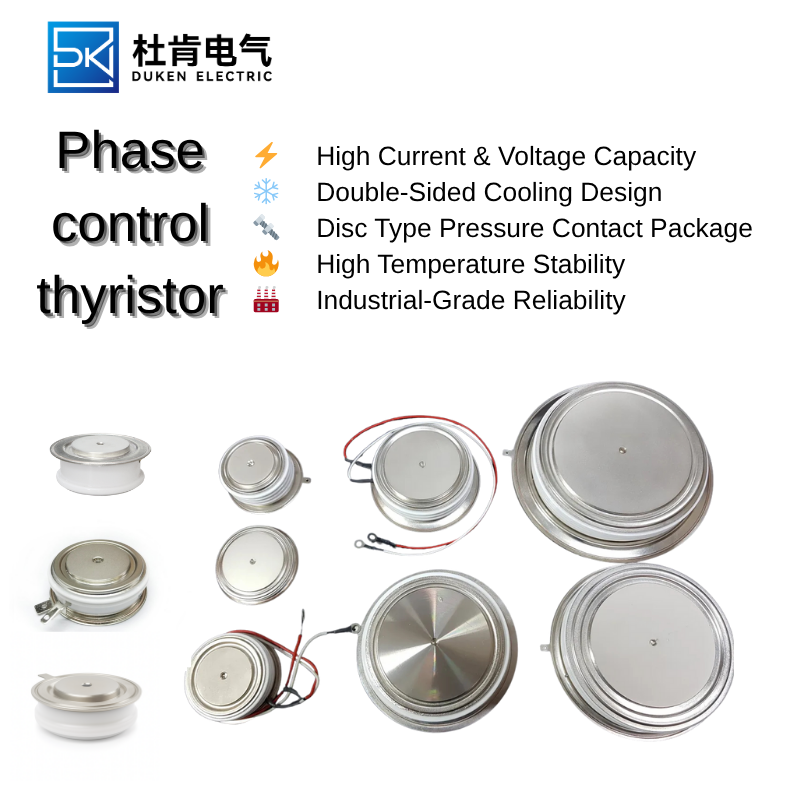
Industrial rectifier systems are the backbone of many heavy-duty electrical processes, from electroplating and smelting to backup energy infrastructure and controlled DC supply systems. As current demand rises and operating conditions become more complex, the value of a 3500A phase control thyristor high performance device becomes increasingly clear. This type of component is designed to do more than switch large currents. It supports control precision, protects system continuity, and helps power engineers maintain safe operation across demanding duty cycles.
Rectifier design is no longer a matter of selecting a high-current semiconductor and assuming the rest will follow. Today’s systems must deliver high efficiency, low failure rates, and predictable behavior even when grid conditions fluctuate or thermal conditions become severe. In these environments, designers often benchmark insulation and blocking characteristics against a battery charging rectifier robust insulation for high voltage 300A phase control thyristor. In compensation and reactive power support applications, engineers often evaluate switching ruggedness with reference to a static VAR compensator (SVC) high dv/dt immunity 300A phase control thyristor. When installations may face extreme ambient conditions, they also consider the behavior expected from a high current switching device extended temperature range (–40°C to +85 °C) 300A phase control thyristor.
The Role of the Thyristor in Rectifier Performance
In a controlled rectifier, the thyristor directly influences output waveform, voltage regulation, efficiency, and harmonic behavior. A well-chosen 3500A phase control thyristor can maintain accurate conduction timing under significant electrical stress, which is essential when downstream loads require smooth and dependable DC power. Any instability in firing or conduction can lead to inconsistent output, reduced process quality, and unwanted stress on transformers, filters, and bus structures.
This matters particularly in battery charging and industrial DC processes, where even moderate fluctuations may degrade equipment performance. A battery charging rectifier robust insulation for high voltage 300A phase control thyristor represents the class of device characteristics needed when electrical isolation and high blocking reliability are critical. In practical terms, good insulation margins reduce the likelihood of partial discharge-related degradation, leakage problems, or premature insulation fatigue in higher-voltage assemblies.
Why dv/dt Immunity and Trigger Stability Matter
Many high-power systems operate in electrically noisy environments. Switching transients, line disturbances, and reactive load behavior can expose semiconductors to rapid voltage changes that challenge gate stability and blocking integrity. That is why power engineers place great importance on dv/dt performance. A static VAR compensator (SVC) high dv/dt immunity 300A phase control thyristor provides a useful reference point for applications where fast voltage transitions are a normal part of operation rather than an occasional abnormality.
If a thyristor lacks adequate dv/dt immunity, unwanted triggering may occur. This can disturb control timing, affect harmonic performance, and increase stress on associated components. In a large rectifier, such instability can cascade into serious operational problems, including uneven current sharing, heating imbalance, and reduced component lifespan. High-performance 3500A devices are therefore expected to combine strong current capability with excellent immunity to false triggering and reliable gate response.
Another often overlooked factor is trigger consistency over time. Gate characteristics should remain stable across repeated switching cycles, not just during initial testing. Aging, thermal drift, and operating stress can all influence trigger behavior, so long-life design quality is essential.
Thermal Demands and Environmental Endurance
High-current rectifiers generate significant heat, and temperature is one of the main causes of semiconductor wear. A high current switching device extended temperature range (–40°C to +85 °C) 300A phase control thyristor highlights the importance of predictable performance over a wide thermal span. While a 3500A device may be installed in a controlled industrial room, many actual sites face dust, airflow limitations, seasonal temperature variation, or enclosure heating from nearby equipment.
Thermal design must account for more than average current. Peak load periods, load ripple, cooling interruptions, and ambient temperature shifts can all influence junction temperature. When thermal behavior is poorly managed, material fatigue accelerates and reliability drops sharply. High-performance phase control thyristors are valuable because they offer not only current capacity but also a structure capable of surviving repeated thermal stress with less degradation.
A battery charging rectifier robust insulation for high voltage 300A phase control thyristor also reminds designers that thermal stress can influence insulation durability over time. In the same way, a static VAR compensator (SVC) high dv/dt immunity 300A phase control thyristor demonstrates that electrical ruggedness and thermal endurance often need to be considered together, especially in fast-response power equipment.
Better Rectifier Design Through Better Device Selection
A robust rectifier is built on balance: current capacity, cooling design, trigger precision, insulation strength, and transient tolerance must all align. The advantage of a 3500A phase control thyristor high performance component is that it strengthens the entire system architecture rather than solving only one electrical requirement. It helps designers reduce control instability, improve service intervals, and support long-duration industrial operation with fewer maintenance disruptions.
In energy storage support, electrochemical production, and process DC supply, the right thyristor can significantly influence uptime and total ownership cost. A high current switching device extended temperature range (–40°C to +85 °C) 300A phase control thyristor serves as a strong design reference for systems exposed to broad environmental variation, while a battery charging rectifier robust insulation for high voltage 300A phase control thyristor remains relevant wherever high-voltage protection margins matter. And in advanced reactive power or switching-sensitive equipment, a static VAR compensator (SVC) high dv/dt immunity 300A phase control thyristor captures the level of transient resilience that many modern installations require.