Key Electrical Parameters to Check Before Buying a 1400A Phase Control Thyristor
Buying a high-current thyristor requires more than comparing catalog titles. A 1400A phase control thyristor is often installed in expensive industrial equipment where downtime, spare part mismatch, and thermal failure can create significant operational losses. To make a reliable purchasing decision, engineers should examine electrical parameters in detail and understand how each rating affects real system behavior.
The datasheet is the most important technical document during selection. It provides the limits and test conditions that define how the component behaves under voltage stress, current conduction, gate triggering, thermal load, and transient events. A device described as datasheet KP1400A‑6500V low leakage current 1400A phase control thyristor should be reviewed not only for its headline ratings, but also for the conditions under which those ratings are measured.
1. Blocking voltage and off-state performance
The blocking voltage rating determines how much voltage the thyristor can withstand when it is not conducting. In high-voltage controlled rectifier systems, the device may spend a large portion of each cycle in the blocking state. Therefore, repetitive peak off-state voltage and repetitive peak reverse voltage are essential parameters.
A 6500V class thyristor may be suitable for medium-voltage stacks, traction-related conversion, industrial DC supplies, and other equipment that requires a high blocking margin. However, the voltage rating should be assessed with the complete circuit in mind. Transformer secondary voltage, line tolerance, switching transients, reverse recovery stress, and overvoltage protection all influence the actual voltage seen by the device.
Low off-state leakage is also important. When reviewing a datasheet KP1400A‑6500V low leakage current 1400A phase control thyristor, buyers should check leakage values at elevated temperature and rated blocking voltage. Low leakage current reduces unnecessary heating and supports stable voltage sharing in series assemblies. This is especially important in systems where several thyristors operate together to reach a higher voltage level.
2. On-state current and conduction losses
The current rating should be matched to the application waveform. The rated average current may assume specific cooling conditions and a defined case temperature. In real equipment, the conduction angle may change continuously, and the current waveform may include harmonics, pulses, or overload cycles.
Forward voltage drop is another crucial parameter. Even a relatively small voltage drop can create large power loss at 1400A. For example, if the device has a forward drop of only a few volts under heavy current, the resulting heat can be several kilowatts. That heat must be removed through the package, clamps, heatsinks, and cooling system.
Engineers should calculate losses under normal load and overload conditions. They should also compare the expected junction temperature with the device limit. Selection is safer when the thyristor operates with adequate thermal margin instead of running continuously near the maximum allowable junction temperature.
3. Surge current and fault survival capability
Industrial power systems often experience short but severe current events. Transformer energization, motor starting, capacitor charging, load faults, and line disturbances can create current peaks far above normal operating current. A thyristor must have enough surge capability to survive these events until protective devices respond.
This is where a high surge current rating Aluminium housing disc package 1400A phase control thyristor becomes highly relevant. Surge current rating is usually specified for a half sine wave or a defined pulse duration. The value should be compared with fuse clearing energy, expected short-circuit current, and system protection timing.
A high surge current rating Aluminium housing disc package 1400A phase control thyristor can improve robustness in demanding applications, but surge rating is not unlimited. Repeated surge events can age the device, weaken interfaces, and increase failure risk. Protection coordination, current limiting, and proper system commissioning remain essential.
4. Gate trigger characteristics and firing reliability
A phase control thyristor must be triggered at the correct point in the AC waveform. If gate drive is insufficient, the device may turn on slowly or unreliably. This can cause uneven current sharing, increased local heating, electrical noise, and poor output regulation.
Gate trigger current and voltage should be compared with the driver circuit. The gate pulse should have enough amplitude, duration, and energy to ensure full turn-on under the worst operating conditions. Temperature, device tolerance, and electrical noise should be considered when setting gate drive margins.
Critical rate of rise of on-state current, or di/dt, is also important. During turn-on, current initially flows through a limited area of the silicon. If current rises too quickly before conduction spreads, localized heating can damage the device. A properly designed gate pulse and suitable circuit inductance help manage this stress.
5. Package structure, cooling, and mechanical requirements
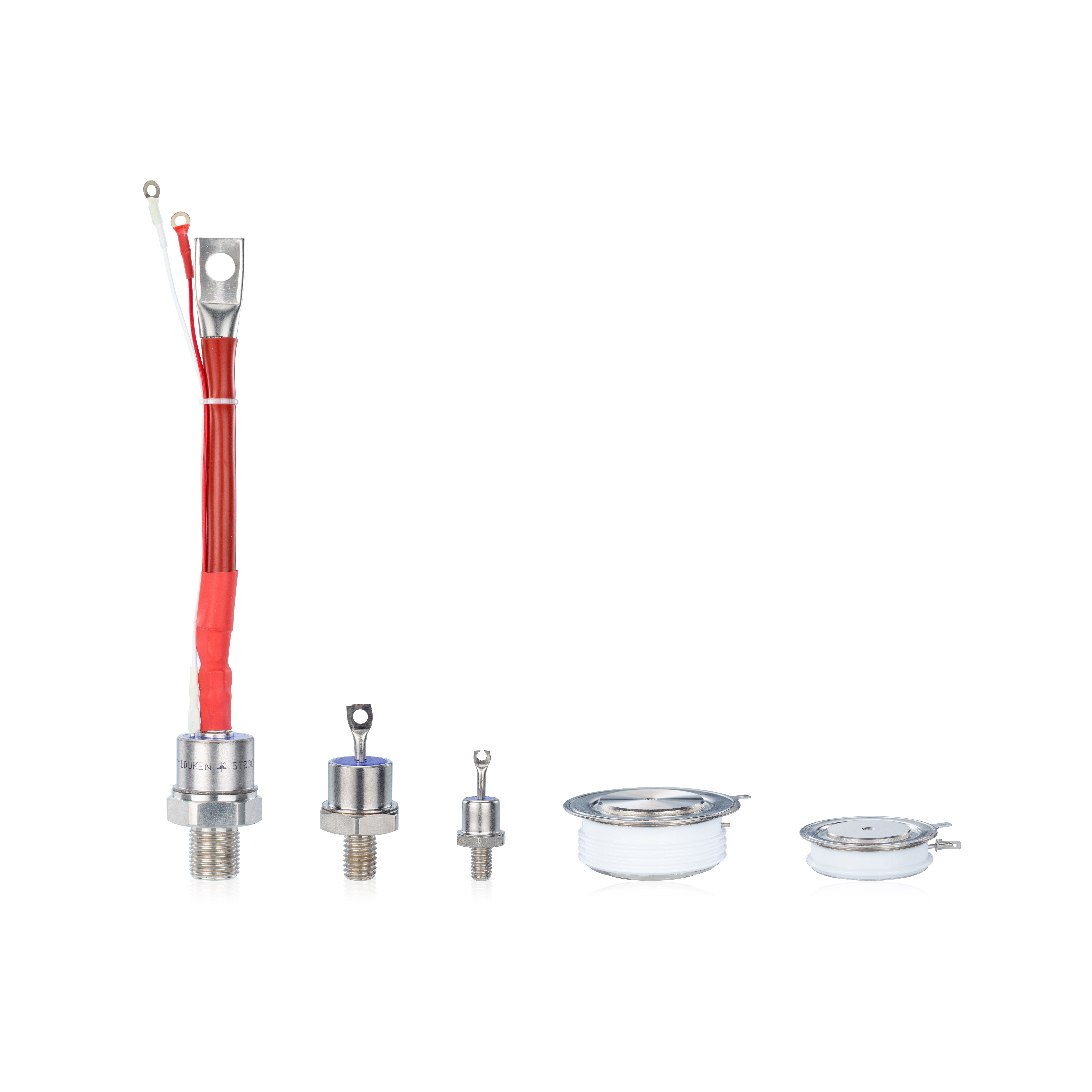
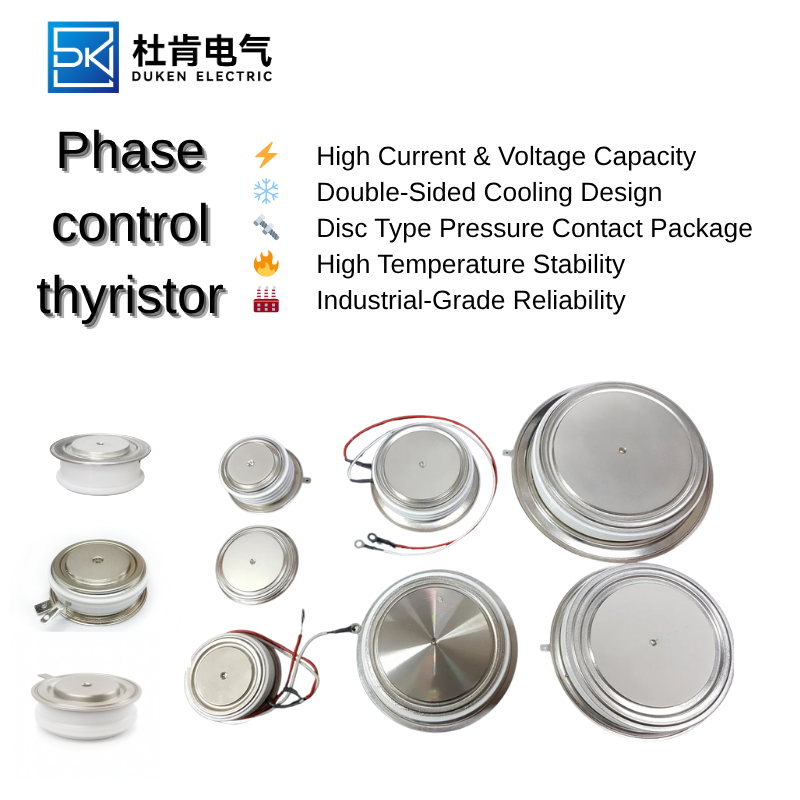
High-current thyristors commonly use disc packages because they support strong pressure contact and efficient cooling from both sides. Aluminium housing adds mechanical strength and helps protect the device in industrial stack assemblies. The package is not just a physical detail; it is part of the electrical and thermal performance of the component.
A high surge current rating Aluminium housing disc package 1400A phase control thyristor should be installed with the correct clamping force. Too little force increases contact resistance and thermal resistance. Too much force may mechanically damage the device. Surfaces should be flat, clean, and aligned to prevent uneven pressure.
Cooling method must also match the load profile. Air cooling may be sufficient in some systems, while water cooling may be necessary for continuous high-current operation. The thermal resistance values in the datasheet help engineers estimate whether the cooling design can keep the junction temperature within safe limits.
6. Final purchasing checklist
Before buying, confirm that the selected thyristor meets voltage, current, surge, leakage, gate, package, and thermal requirements. The datasheet KP1400A‑6500V low leakage current 1400A phase control thyristor should be compared with actual circuit data, not just with a previous part number. Replacement decisions should include mechanical dimensions, clamping method, cooling interface, polarity, and control compatibility.
Procurement teams should request consistent documentation, traceability, and technical support. For critical equipment, sample testing or engineering approval is recommended before bulk purchase. A technically suitable thyristor can reduce maintenance risk, improve system reliability, and extend operating life in demanding power control applications.